
Angel numbers are repeating number sequences — 111, 222, 444, 11:11 — that people notice on clocks, receipts and license plates and read as a message from the universe or their guardian angels. Angel Clock keeps a page for each of the twenty-one numbers people look up most. They do not all behave the same way, and the difference is not a matter of interpretation — it is a matter of how a clock is built.
Seven of them appear on a clock face on their own, fourteen times a day between them. Five can never appear at all: an hour stops at 59 minutes, so 6:66 does not exist and neither does 9:99, and a clock has no hour zero to put in front of 000. The last three are real minutes the app does not watch for — a run rather than a repeat, a pair of pairs, and midnight, which only a 24-hour face writes as 0000. Sorting them this way costs nothing and answers most of what people actually came to ask.
Five numbers outside the app have pages of their own too, read the way the tradition reads them and checked against a clock: 1221, a palindrome at 12:21; 1144, at 11:44; the climb 123 and the countdown 321, at 1:23 and 3:21; and 4444, which no clock can show, because no clock has a forty-fourth hour.
How common each one is as a birth number
Angel Clock reduced every birthday from 1950 to 2013 — 23,376 dates — and counted where they land. The clock number and the birth number are different things: this column is the second one.
| Number | Meaning | On the clock | Birth number |
|---|---|---|---|
| 999 | Release | never | 11.1% · 1 in 9 |
| 111 | Beginnings | 1:11 | 11.1% · 1 in 9 |
| 333 | Support | 3:33 | 11.1% · 1 in 9 |
| 888 | Abundance | never | 11.1% · 1 in 9 |
| 555 | Change | 5:55 | 11.1% · 1 in 9 |
| 777 | Luck | never | 11.1% · 1 in 9 |
| 666 | Balance | never | 10.3% · 1 in 10 |
| 444 | Protection | 4:44 | 8.1% · 1 in 12 |
| 1111 | Make a wish | 11:11 | 6.5% · 1 in 15 |
| 222 | Alignment | 2:22 | 4.6% · 1 in 22 |
000, 0000, 505, 717, 818, 911, 919, 1122, 1133, 1212 and 1234 are missing from that table on purpose: a birth number reduces to a single digit, or stops at 11, 22 or 33, so none of them can ever be one. Yours is on the angel number calculator.
Angel Clock carries seven more in short form — 11, 22, 33, 44, 55, 77 and 99 — each with its own reading in the app and no page of its own here. Three of them — 11, 22 and 33 — are the master birth numbers, and all twelve possible birth numbers are counted on the data page.
Why three of the numbers sit below the rest
The table has a shape that is not obvious until you add it up. Six numbers sit at 11.1%, and three sit under it — 4 at 8.1%, 6 at 10.3%, 2 at 4.6%. They are not unlucky. Each one is missing exactly the birthdays that its master number took: 4 plus 22, 6 plus 33 and 2 plus 11 each come back to the same 11.1% the others have.
So the master numbers are not a separate category sitting alongside the rest. They are carved out of three specific numbers, and those three are lighter by exactly that much. If your number is 2, the 11s were taken from your share. Angel Clock counted this rather than repeating it, which is why the figures land where they do.
Why the split falls where it does
Both halves of a clock face were decided thousands of years ago and neither was chosen with angel numbers in mind. The twelve hours come from Egypt, where day and night were each divided into twelve and the night was tracked by thirty-six star groups called decans. The sixty minutes come from Babylon, whose counting ran in base sixty — a base kept because sixty divides evenly so many ways that thirds and quarters of an hour come out as whole numbers.
That second choice is the whole reason four of these numbers are impossible. Had the hour been split into a hundred parts, 6:66 and 9:99 would arrive twice a day like everything else, and this page would have one list instead of three. Angel Clock did not invent the split and cannot move it — it just counts what the face can actually show. And the face itself is a setting: angel time has the six more patterns a 24-hour clock adds, and what your phone shows instead of them.
What these numbers are
An angel number is a repeating pattern of digits that a person reads as meaningful — 1:11 on a clock, 444 on a receipt, 888 on a plate. The practice is modern in this form, older in its parts, and it does not claim to be arithmetic. Angel Clock treats it as what it is: a habit of noticing, with one line of meaning attached to each number, and no promises about anyone’s week.
There is a second, separate number in the tradition — the one you get by reducing your birth date to a single digit. It is fixed for life, it has nothing to do with the clock, and it is the one most people are surprised to learn is not rare. The calculator works it out and shows how many birthdays share it.
All twenty-seven as one chart
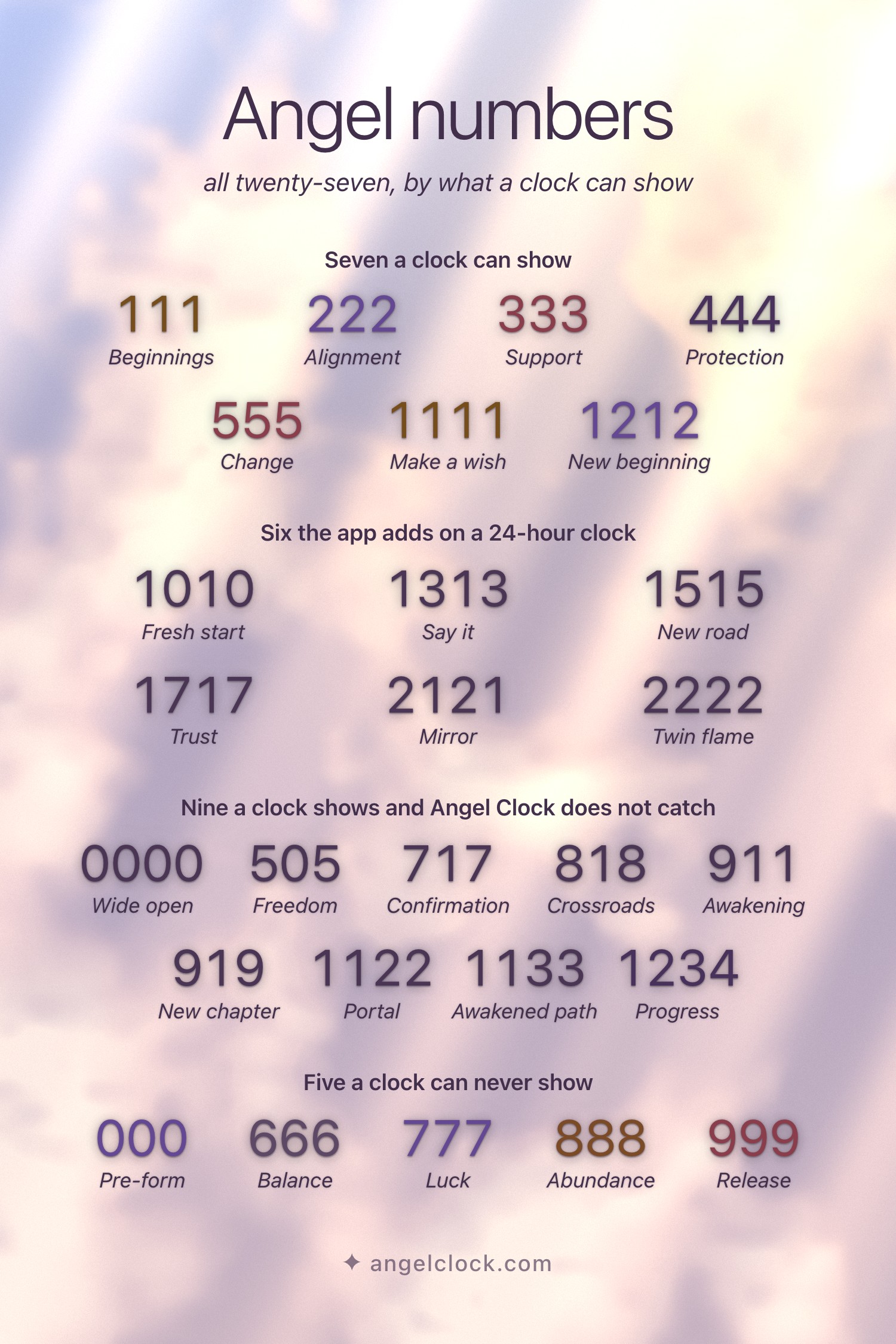
The same sort on one image, with the six numbers the app adds on a 24-hour clock included: what a clock can show, what it shows that Angel Clock does not catch, and what no clock can show at all. Tap it for the full 1500×2250 file to save or print — free, no sign-up.
What are angel numbers and what do they mean?
Angel Clock carries one line for each: 000 pre-form, 111 beginnings, 222 alignment, 333 support, 444 protection, 555 change, 666 balance, 777 luck, 888 abundance, 999 release, 0000 wide open, 1111 make a wish, 1122 a portal, 1212 a new beginning, 1234 progress. One line and no more — the longer readings sold elsewhere were written without knowing whose life they were about.
How many angel numbers are there?
No tradition fixes a total, so any count is a choice, and this is ours. Angel Clock reads twenty-seven: the twenty-one on this page, and six more it catches on a 24-hour clock — 10:10, 13:13, 15:15, 17:17, 21:21 and 22:22, counted on the angel time page. In a day, a 12-hour face brings seven repeating patterns, each twice, so fourteen moments; a 24-hour face brings thirteen, once each.
Which angel numbers can you see on a clock?
Seven: 1:11, 2:22, 3:33, 4:44, 5:55, 11:11 and 12:12, each twice a day on a twelve-hour face. Angel Clock catches all seven. The triples 666, 777, 888 and 999 cannot appear on any clock, because no hour has 66 or 99 minutes in it.
Which angel number is the rarest?
As a birth number, 33 — Angel Clock counted 23,376 birthdays and it lands on 0.8% of them, about 1 in 120, with 22 next at 3.0%. As a moment, all of them are rare in the same way: a repeating minute is under one percent of the week, and most pass while you are looking somewhere else.
Are angel numbers real?
Two things are true at once, and most pages pick one of them. The numbers are real in the plain sense: 4:44 arrives twice a day whether or not anyone is watching, and the arithmetic behind a birth number is arithmetic — you can do it on paper. Whether a number carries a message is not something Angel Clock can settle for you, and it does not pretend to: it makes no predictions and takes no side. What it can be is accurate about the part that is checkable — including how often a repeating minute actually comes round, which is under one percent of the week.
What should I do when I see one?
Nothing is required, and a page that hands you a ritual is inventing it. What people actually do is notice — and then lose it, because the minute passes in sixty seconds and the memory of it by evening. Angel Clock’s whole job is the second half: it keeps the minute you caught, so the thing you noticed is still there tomorrow.
Why am I suddenly seeing them everywhere?
Because the clock did not change and your attention did. On a 12-hour face the repeating minutes are the same fourteen moments they were last month — 1:11, 2:22, 3:33, 4:44, 5:55, 11:11 and 12:12, each twice a day, fourteen out of the 1,440 minutes you live through, just under one per cent. Nothing about that arrives in waves. What arrives in waves is noticing, and the effect has a name: the frequency illusion, named by the linguist Arnold Zwicky in 2005. Angel Clock does not argue with the feeling; it just knows exactly how many of those minutes there are. The longer answer, tradition and psychology side by side, is on why do I keep seeing angel numbers.
Does everyone see the same angel numbers?
No, and the reason is a setting rather than a gift. A 12-hour clock can repeat seven patterns; a 24-hour clock can repeat thirteen. So a phone in the United States, which ships on the 12-hour face, can never show you 21:21 or 22:22 at all — they read 9:21 and 10:22 — while the same phone in Berlin shows them every day. Two people can watch the same hour and be shown different numbers, and neither of them is doing it wrong. Angel Clock follows the face your phone is set to rather than the one it wishes you had, so its watch list changes with that setting; angel time has both lists in full.
What if I see them all day, not just on the clock?
Then most of what you are seeing did not come from a clock, and that is worth knowing rather than glossing. A clock has ceilings: an hour stops at 59 minutes, so 6:66 and 9:99 do not exist, and there is no hour zero to put in front of 000. Receipts, plate numbers, page numbers and totals have no ceilings at all, which is why those numbers turn up there and only there. Angel Clock counts what a face can actually show and says so on every page that needs it.
Are these twin flame numbers?
Some traditions read certain repeats — 1111, 2222, 1212 — as twin flame signs, and Angel Clock neither confirms that nor argues with it: it is a reading, and readings are not the kind of thing a clock settles. What the app can be exact about is which of these a clock can double for you at all. A 12-hour face repeats seven patterns; a 24-hour face repeats thirteen. And 666 gets read this way as often as any of them — separation, reunion, the whole vocabulary — though no clock has ever shown 6:66, because an hour stops at 59 minutes. Whatever was seen there, it was not the time. The readings themselves, number by number and stage by stage, are on twin flame angel numbers.
Can you use an angel number to manifest something?
Angel Clock makes no predictions and offers no method, so the honest answer from us is no — and the reason is worth more than the answer. These minutes are not a lever you pull: 4:44 arrives twice a day whether anyone is hoping for it or not, fourteen such moments in a 12-hour day out of 1,440. Nothing about that responds to intent. What the app does is smaller and true: it notices the minute for you and keeps it. What you do with having noticed is yours.
Does an angel number mean someone is thinking of me?
Angel Clock has nothing to say about that, and saying so is the honest answer rather than a modest one. A clock knows the time; it does not know who is thinking about you, and no arithmetic in this app could find out. What we can be exact about is the minute itself — when it comes, how often, and whether your clock face can show it at all. Everything past that belongs to you, not to us.
Where to start
If a number has been finding you, start with its own page — 444 and 333 are the two people ask about most. If you want to know which number is yours rather than which one is on the wall, that is the angel number calculator. And why you keep seeing 11:11 has the full tables for both clock faces, including the honest part about why it feels like more than it is. If the question is what Scripture says, angel numbers in the Bible answers it plainly, and what this year adds up to for your birthday is on the 2026 angel number.
And if you would rather carry the number than read about it, every one of them has a free wallpaper drawn by the same sky, built to sit under the lock screen clock instead of behind it.
Angel numbers are a cultural practice, not a prediction. Nothing on this page is advice about health, money or relationships.